Basketball Journal
Three-point volume and shooting quality are different questions
A team can take many three-pointers without creating good opportunities, or generate useful chances that miss on a particular night. Volume, accuracy and shot quality are different questions. Keep them separate before deciding what a shooting pattern means.
Count attempts before judging the percentage
The NBA glossary defines three-point attempts as the number taken and three-point percentage as makes divided by attempts. A high percentage from a few shots and the same percentage over a large sample carry different uncertainty.
Check the period and role. One player taking late-clock attempts and another receiving open catches may face different tasks. A total alone does not describe how the opportunities were created.
| Question | Measure or evidence | Limit |
|---|---|---|
| How often? | Attempts and share of shots | Does not establish quality |
| How accurately? | Makes divided by attempts | Needs sample context |
| How valuable? | Points and relevant efficiency measures | Does not include every possession cost |
| How well created? | Video and available tracking context | Location alone is incomplete |
Use arithmetic without making it a strategy rule
In a fictional ten-shot example, four made threes produce 12 points while five made twos produce 10. That illustrates why equal field-goal percentages do not have equal scoring value. It does not prove every outside shot is preferable.
The NBA’s effective field-goal percentage adjusts for the extra value of made threes. It remains one measure: free throws, turnovers and the wider possession sequence require other information.
- Keep attempt count beside accuracy.
- Use consistent filters and sample periods.
- Watch the creation of the chance.
- Avoid turning one hot or cold night into a permanent verdict.
Describe the decision, not only the result
A well-created attempt can miss and a difficult one can go in. Ask whether the offence repeatedly finds suitable chances for its players. Then check whether the observed pattern persists beyond one game.
Do not use “shot quality” as a confident label without explaining the evidence. State whether the claim comes from video, a particular data definition or an interpretation, and keep the limits visible.
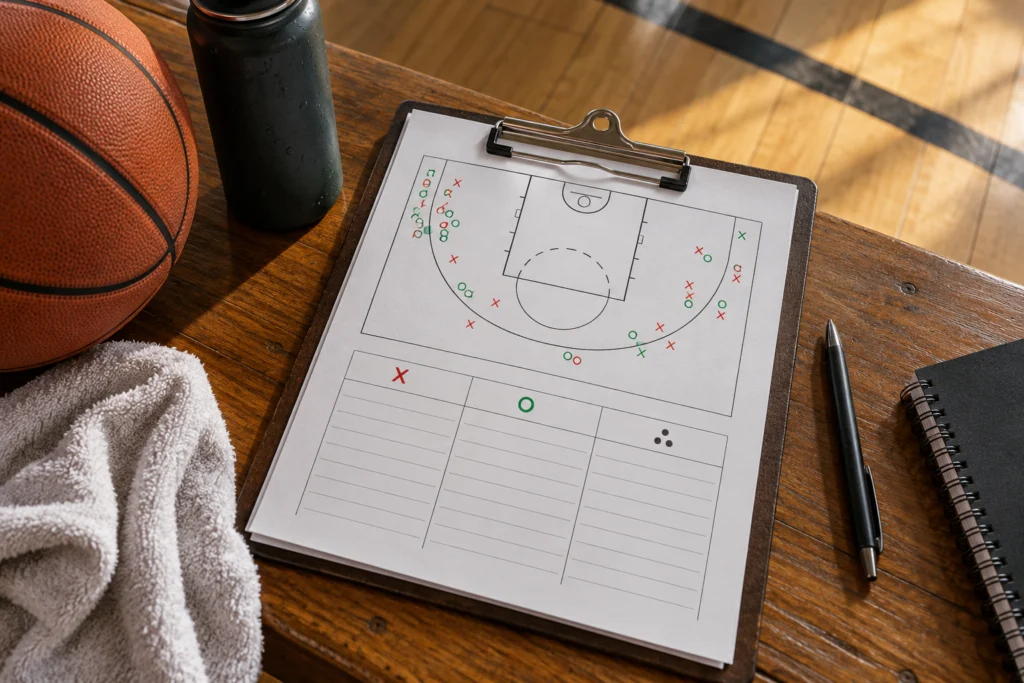
Try a two-column video note for attempts from the same area: one column records what was visible before release, the other records the outcome. An uncontested catch with time and a hurried attempt near the clock’s end may share a chart location. Explain that difference before adding a quality label. If the camera angle hides the defender, mark the observation uncertain rather than deciding from the make or miss.
Questions and answers
Are more threes automatically better?
No. Creation, accuracy, roles and the whole possession matter.
Does eFG% include every offensive factor?
No. It adjusts field-goal shooting value but is not a complete offence measure.
Are the ten-shot examples real team results?
No. They are explicitly fictional arithmetic illustrations.
Sources: nba.com.