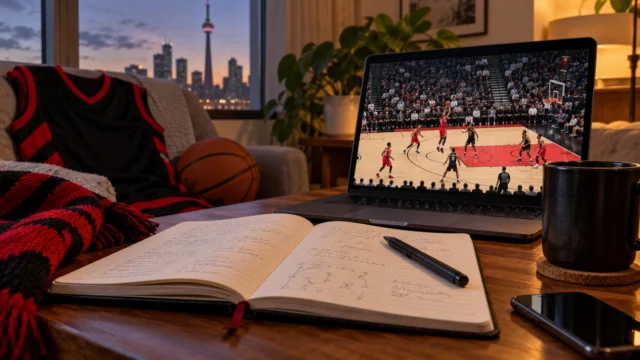
Basketball Journal
How to read an NBA game beyond the final score

The final score tells you who won, but not how the game developed. A useful viewing method combines a few statistics with what happened on the court. Start with possessions and decisions rather than trying to follow every advanced metric at once.
Ask what each team created
Notice how an offence reaches its shots: early transition, movement, a difficult late attempt or a second opportunity. The same point total can come from different patterns. A made shot does not prove the decision was good, and a missed open shot does not prove it was bad.
Keep turnovers in view. The NBA glossary describes them as the offence losing the ball to the defence. Ask whether a lost possession came from pressure, an ambitious pass or another context instead of treating every turnover as identical.
| Area | Watch | Check afterwards |
|---|---|---|
| Possessions | How quickly teams reach decisions | Pace and the relevant game context |
| Shots | Location and how space is created | Attempts and shooting measures |
| Turnovers | Where possession is lost | The count alongside video |
| Lineups | Which groups solve or create problems | Minutes and opponent context |
Compare opportunity and efficiency
The NBA defines offensive rating in terms of points per 100 possessions. That separates scoring efficiency from simply having more possessions. Raw points remain useful, but they answer a different question.
Do not turn one game’s rating or one player’s plus-minus into a complete judgement. Teammates, opponents, minutes and a small sample can influence the result. Use the number to choose a question for review.
- Watch a few possessions without following only the ball.
- Note one repeatable offensive pattern.
- Keep result and decision quality distinct.
- Check definitions before comparing unfamiliar statistics.
Write a short explanation after the game
Try three sentences: what changed, which evidence supports it and what remains uncertain. Avoid a story in which every basket was inevitable because you know the final score.
A good explanation can admit that shooting variation mattered. Basketball is more interesting when analysis describes the process honestly rather than turning the scoreboard into proof of every opinion.
As a viewing exercise, choose two possessions and pause before seeing the shot result. Note the space, remaining clock and passing option you can actually see. Then watch the outcome and keep the original note. A difficult made shot and a missed open attempt can then be discussed without quietly rewriting your judgement to match the scoreboard. This is an observation exercise, not a claim that one possession decides the game.
Questions and answers
Does the winning team make every better decision?
No. A result summarises the game but does not grade each possession.
Are raw points enough to compare offences?
They omit the number of opportunities. Possession-based measures add another view.
Should I learn every advanced stat first?
No. Begin with a few defined measures and connect them to what you watch.
Sources: nba.com.